

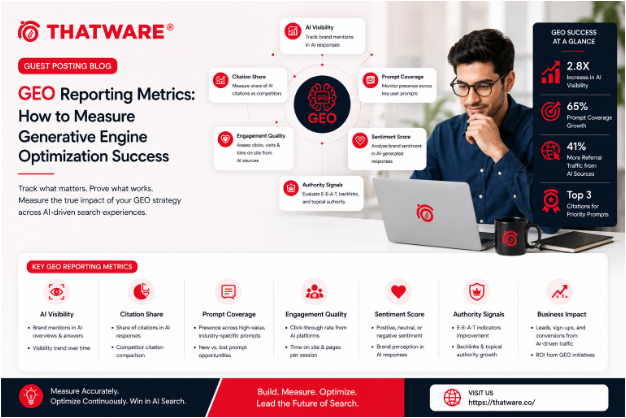
Most marketing teams are pretty comfortable with the usual dashboards — organic traffic, keyword rankings, click-through rates, bounce rates. It’s familiar territory. But when you start investing in Generative Engine Optimization, those same dashboards suddenly feel like they’re telling you half the story. Maybe less than half. And that’s not a comfortable place to be when someone in finance is asking what the ROI looks like.
Measuring GEO success is genuinely different from measuring traditional SEO. Not harder, necessarily — just different. The signals live in different places, they move at different speeds, and some of them require a new mental model entirely. Let’s get into what actually matters, what you should be tracking, and why some of the old metrics don’t quite apply anymore.
Why Traditional Metrics Fall Short
Here’s the thing about AI-generated answers: they often don’t send a click. Someone asks Perplexity “what’s the best project management software for remote teams” and gets a paragraph-length answer with three or four vendor mentions — and maybe they click through, maybe they don’t. The value of being cited there isn’t captured in your Google Analytics session data.
This is the zero-click problem, and it’s real. Your brand could be consistently mentioned in AI answers across hundreds of relevant queries, driving awareness, trust, and consideration — and your traffic dashboard would show nothing. This is why building a GEO-specific reporting framework isn’t optional. It’s how you prove (and improve) what’s actually working.
That said, dismissing traffic entirely would be a mistake. AI referral traffic — sessions originating from tools like Perplexity, ChatGPT’s browsing feature, or AI Overview clicks — is trackable and growing. It’s just one piece of a larger picture.
The Core Metrics That Actually Matter
GEO services worth their cost will build reporting around a handful of metrics that collectively tell you how your brand is performing in the generative search ecosystem. Here’s what that looks like in practice.
AI Citation Rate is probably the most fundamental. This measures how often your brand, products, or content are cited or referenced when AI tools answer queries in your category. Agencies typically track this by running a defined set of target prompts — questions your ideal customers are actually asking — across multiple AI platforms, then recording how often you appear. A baseline is established early, and changes over time indicate whether your optimization work is landing.
Prompt Coverage goes one level deeper. It’s not just whether you appear, but across how many distinct query types. A brand that shows up for three prompts but has zero presence across thirty others has a very different profile than one with moderate presence across twenty-five. Widening prompt coverage is often the early-stage goal before deepening it.
Sentiment and Framing matters more than people expect. Being cited isn’t always the same as being cited well. Is your brand mentioned as a recommended option? A cautionary example? Simply a neutral reference? Tracking the context and framing of your citations — especially over time as content and entity signals evolve — gives you a qualitative layer that pure frequency numbers miss.
Share of AI Voice is the GEO equivalent of share of voice in traditional media. When AI tools discuss your category, what percentage of the relevant mentions belong to your brand versus competitors? This is a competitive metric, and honestly one of the more motivating ones — it puts your performance in context rather than in isolation.
Platforms to Track Across
One thing that catches clients off guard early on: GEO reporting isn’t about one platform. ChatGPT, Perplexity, Google AI Overviews, Bing Copilot, Claude — these tools have different training data, different retrieval mechanisms, and different tendencies. Your brand might appear consistently in Perplexity and barely register in Google’s AI Overviews, or vice versa.
A solid reporting setup tracks across at least three platforms, with particular attention to whichever ones your target audience actually uses. For B2B buyers, Perplexity and ChatGPT tend to dominate. For consumer queries, Google’s AI Overview is hard to ignore given sheer volume.
Connecting GEO Metrics to Business Outcomes
This is where reporting gets a bit more nuanced — and where working with the best GEO agency makes a real difference. Citation rate and prompt coverage are process metrics. What leadership ultimately wants to know is: does this translate to pipeline, revenue, or brand equity?
The honest answer is that the connection is real but indirect, and the timeline is longer than most paid channels. AI citations influence consideration during research phases — often before a prospect ever visits your site. Measuring this requires a combination of approaches: surveying customers about how they first heard of you, tracking branded search volume over time, monitoring AI referral traffic trends, and using attribution models that account for longer buying cycles.
Some companies are starting to use brand lift studies specifically designed for AI visibility — measuring unaided awareness among audiences exposed to frequent AI citations versus those who aren’t. It’s an early methodology, but the direction is right.
Reporting Cadence and What Good Looks Like
Weekly spot-checks on key prompts. Monthly full reporting across citation rate, prompt coverage, sentiment, and share of voice. Quarterly business review connecting GEO metrics to pipeline and revenue indicators.
That’s a reasonable cadence for most organizations. In the early months, weekly tracking is especially valuable because you’re establishing baselines and identifying which optimization moves are generating early signals.
What good looks like varies by stage. In the first 90 days, “good” might just be establishing a baseline and seeing citation rate tick up in two or three platforms. At six months, you want to see clear prompt coverage expansion and improving share of voice. In twelve months, the brand lift and traffic signals should be measurable.
The Honest Reality of GEO Measurement
It’s still early days for this field. There’s no single universal tool that does for GEO what Google Search Console does for traditional SEO. Most agencies are building custom tracking frameworks — some more rigorous than others. Part of evaluating an agency is asking specifically how they measure, what platforms they track, how they define citation quality, and what their reporting process looks like.
Metrics without context are just numbers. The best GEO reporting tells you not just what happened, but what it means — and what to do next. That interpretive layer, honestly, is where a lot of the value lives. Anyone can pull citation counts. Knowing what’s driving them, and how to move them in the right direction, is the actual skill.
GEO is a long game. But that doesn’t mean it’s an unmeasurable one. Build the right reporting framework from day one and you’ll have both the proof points you need and the navigation system to keep improving.